
TL;DR

Get health and wellness essentials delivered free with Prime
- Fast, free delivery on millions of items
- Prime Video, Amazon Music and more included
- Member-only deals all year
UC Davis Health is testing whether a home medication dispenser made by HiDO Health can help older adults with mild cognitive impairment or dementia take prescriptions as scheduled and let approved caregivers check whether doses were taken. The one-year study will enroll 50 people, with half using the device and half continuing their usual medication routine; results are not yet available.
UC Davis Health researchers are testing an AI-assisted medication dispenser to see whether it helps older adults with mild cognitive impairment or dementia take prescription drugs as scheduled and gives caregivers a record of medication use. The one-year clinical trial will include 50 participants, divided between people using the HiDO Health device with training and support and people who continue their usual medication routine.
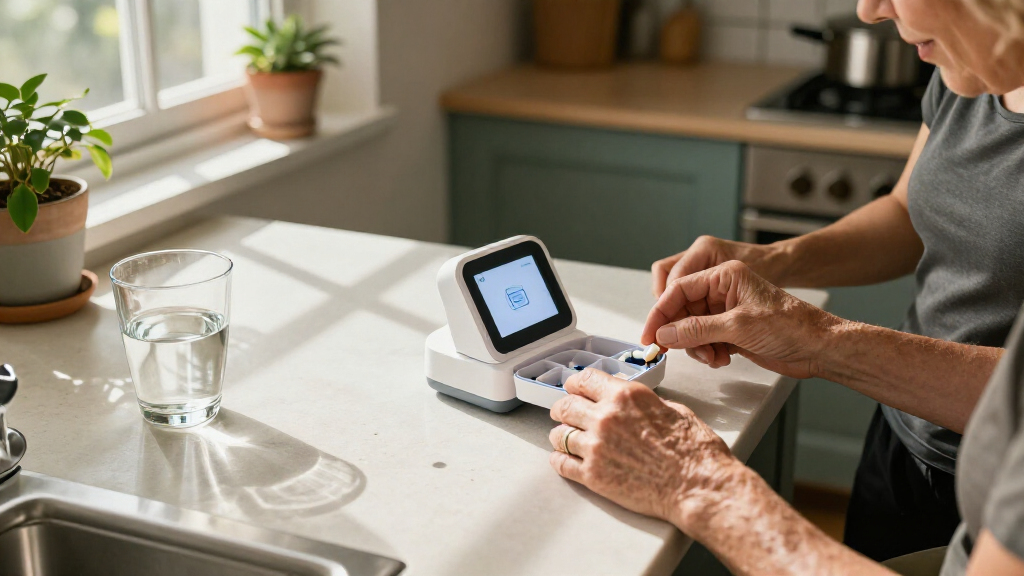
The countertop device, created by HiDO Health, is about 17 inches tall and is designed to hold a 90-day supply of up to seven medications. It is intended to deliver the correct medication at the scheduled time, verify who is taking it and record whether it was taken. Approved caregivers can receive information remotely. The study will examine whether those functions work in everyday use, rather than treating the device’s capabilities as established outcomes.
Researchers will measure medication adherence, cognition and daily functioning during the year-long study. They will also collect blood samples to monitor indicators such as cholesterol and glucose for conditions treated with participants’ medications. A UC Davis Health pharmacy team will review participants’ prescriptions as a safety measure before they start.
The study is funded by a $2.48 million National Institute on Aging grant through its Phase II Small Business Innovation Research program. Neuropsychologists Alyssa Weakley and Sarah Tomaszewski Farias are leading the research. The report says prior peer-reviewed research found early evidence that HiDO’s device is practical, accurate and easy to use for people with dementia and caregivers; the new trial is intended to test its effects and identify who may benefit.
Medication Support Beyond Reminders
Medication routines can be difficult for people experiencing memory and thinking problems, and a missed or mistimed dose may leave families unsure whether a prescription was taken. The device is being tested as a way to record medication use, rather than relying only on an alarm or on whether a pill has been removed from a conventional organizer.
That distinction could matter to relatives who do not live with the person they support. In the report, 88-year-old Marianne Blake’s daughter, Patty Soulsby, describes difficulty knowing whether her mother has taken morning and evening pills. A remote record could potentially reduce some checking and uncertainty, while supporting a person’s ability to remain at home. Those are possible benefits, not findings from this trial.
Evidence from a controlled study may also help clinicians and families judge whether a consumer-facing device performs as intended. The researchers say the trial will look at adherence and daily functioning, not just whether participants can operate the dispenser. Results could inform whether the technology is useful, for whom, and what training caregivers need.
AI medication dispenser for seniors
As an affiliate, we earn on qualifying purchases.
As an affiliate, we earn on qualifying purchases.
Why Researchers Are Testing It
The trial addresses a practical challenge in dementia care: managing several prescription medicines while memory or thinking abilities change. The Medical Xpress report cites estimates that 4.3 million older Americans living alone have memory and thinking problems, accounting for about a quarter of older adults with dementia or mild cognitive impairment. It also cites a national study finding that more than 13% of older adults with dementia had difficulty managing medication.
Existing tools range from alarms to plastic pill organizers. These can help people remember a schedule or show that a pill was taken out of a compartment, but they do not necessarily confirm that the person swallowed the medication. HiDO’s system is designed to provide a record and share it with approved caregivers. Whether it improves adherence compared with usual routines is the question the UC Davis trial is set up to examine.
The study includes people with conditions ranging from mild cognitive impairment to moderate dementia. Researchers will compare participants using the device, with support, against those following their existing routines. The report describes earlier research as preliminary evidence of usability; it does not provide results from the new trial.
“Mom’s pretty good about taking her morning pills, but sometimes she won’t take them until 2 p.m. or not at all. The evening pills are the harder ones to remember to take.”
— Patty Soulsby, daughter of participant Marianne Blake
medication management device for dementia
As an affiliate, we earn on qualifying purchases.
As an affiliate, we earn on qualifying purchases.
Trial Outcomes Are Still Pending
The trial has not yet established that the device improves medication adherence, cognition, health indicators or independence. The report gives the planned enrollment and study design but does not provide a start date, recruitment status, interim findings or an expected date for results.
It is also not clear how the system will perform across participants with different levels of cognitive impairment, or whether benefits would extend beyond the study setting. Researchers say they want to identify which patients benefit most and how caregivers can use the system effectively. The study’s size—50 participants—means its findings will need to be interpreted in light of its scope.
The reported 71% higher odds of hospitalization associated with medication errors is a contextual statistic cited in the source report; it is not an estimate of the device’s effect. The trial will need to produce its own evidence before any claim that the dispenser prevents errors or hospitalizations can be made.
pill organizer with remote monitoring
As an affiliate, we earn on qualifying purchases.
As an affiliate, we earn on qualifying purchases.
One-Year Follow-Up and Results
Researchers plan to follow the 50 participants for one year, comparing the device group with those continuing their usual routines. Medication adherence, cognition and daily functioning will be measured, alongside blood indicators relevant to participants’ treated conditions. Pharmacy review will take place before participants begin.
The next meaningful development will be information on enrollment and, later, the study’s findings. The report does not specify when recruitment will finish or when results will be published. Until those data are available, the device’s effectiveness for older adults with memory loss remains under evaluation.
automatic medication dispenser for elderly
As an affiliate, we earn on qualifying purchases.
As an affiliate, we earn on qualifying purchases.
Key Questions
What is the clinical trial testing?
UC Davis Health researchers are testing whether a HiDO Health medication dispenser helps people with mild cognitive impairment or dementia take prescriptions as scheduled and allows approved caregivers to check whether doses were taken.
How many people will take part?
The planned study includes 50 participants. Half will use the device with training and support, while the other half will continue their usual medication routine.
How long will the participants be followed?
Researchers plan to follow participants for one year, measuring medication adherence, cognition and daily functioning and collecting blood samples for health indicators such as cholesterol and glucose.
Has the device been shown to improve medication use?
Not in this trial yet. The source report describes early peer-reviewed evidence on practicality, accuracy and ease of use, but the new study is intended to assess outcomes. No results from it are reported.
Who is funding the study?
The trial is supported by a $2.48 million National Institute on Aging grant through the agency’s Phase II Small Business Innovation Research program.
Source: rss
Columbus Day / Indigenous Peoples' Day Picks
long weekend sales
As an affiliate, we earn on qualifying purchases.