The best blood pressure monitors combine a cuff that fits correctly with clear readings and a routine you can follow consistently. My best overall pick is the OMRON Silver Upper Arm Blood Pressure Monitor for straightforward home tracking, while the OMRON Platinum stands out for buyers seeking AFib screening and the iHealth Track Smart for its wide-range cuff. The main tradeoffs are simplicity versus connected features, upper-arm stability versus wrist portability, and standard readings versus added heart-rhythm tools. Cuff fit and correct measuring technique matter more than a long feature list. Read on for the full breakdown and guidance on choosing a monitor that fits your needs.

Get health and wellness essentials delivered free with Prime
- Fast, free delivery on millions of items
- Prime Video, Amazon Music and more included
- Member-only deals all year
Key Takeaways
- Upper-arm models lead this lineup for routine home tracking: they are the default picks when stable positioning and a familiar cuff setup matter more than compactness.
- OMRON Silver is the straightforward all-around choice: it keeps the focus on standard blood pressure readings, while OMRON Platinum and Gold add AFib-related screening features.
- Extra heart data is a specific-use feature, not a substitute for care: the OMRON Complete adds an EKG function, but buyers should choose it only if that added measurement fits their clinician-guided plan.
- Cuff fit can matter more than brand or app features: iHealth Track Smart calls out a wide-range cuff, while wrist models avoid an upper-arm cuff but require careful positioning.
- Connected and portable designs involve tradeoffs: wireless OMRON Evolv and iHealth Neo favor app-linked tracking, while the rechargeable Oklar wrist monitor favors compact storage over the usual upper-arm format.
| OMRON Silver Upper Arm Blood Pressure Monitor with Cuff |  | Best for Connected Everyday Tracking | Measurement type: Upper arm blood pressure | Cuff fit: Arms 9–17 inches | On-device storage: Up to 30 readings | VIEW LATEST PRICE | See Our Full Breakdown |
| iHealth Neo Wireless Upper Arm Blood Pressure Monitor |  | Best for Simple, Rechargeable Use | Measurement type: Upper arm blood pressure | Operation: One button | Measurement time: 30–60 seconds | VIEW LATEST PRICE | See Our Full Breakdown |
| OMRON Platinum Upper Arm Blood Pressure Monitor with AFib Detection |  | Best for Two Users and AFib Screening | Monitor type: Upper arm blood pressure monitor | Heart rhythm screening: Atrial fibrillation detection | Reading storage: 100 readings per user; two-user support | VIEW LATEST PRICE | See Our Full Breakdown |
| OMRON Complete 2-in-1 Upper Arm Blood Pressure Monitor with EKG |  | Best for Blood Pressure and EKG Readings | Measurement types: Blood pressure and EKG | Cuff fit: Arms 9–17 inches | On-device storage: Up to 90 readings | VIEW LATEST PRICE | See Our Full Breakdown |
| Oklar Rechargeable Wrist Blood Pressure Monitor |  | Best Compact Wrist Monitor | Measurement type: Wrist blood pressure | Measurement time: About 35 seconds | Memory capacity: Up to 240 readings for two users | VIEW LATEST PRICE | See Our Full Breakdown |
| Oklar Upper Arm Blood Pressure Monitor for Home Use |  | Best for Simple Two-Person Tracking | Monitor type: Upper-arm blood pressure monitor | Operation: One-button | Display: Backlit LED | VIEW LATEST PRICE | See Our Full Breakdown |
| OMRON Evolv Wireless Upper Arm Blood Pressure Monitor |  | Best Compact Connected Monitor | Monitor type: Wireless upper-arm blood pressure monitor | Cuff fit: Arms 9–17 inches | On-device storage: Up to 100 readings | VIEW LATEST PRICE | See Our Full Breakdown |
| Automatic No-Wrap Upper Arm Blood Pressure Monitor |  | Best for Easy Cuff Placement | Cuff type: Barrel-style, no-wrap | Arm circumference: 8.7–15.7 inches (22–40 cm) | Measurement time: Approximately 30 seconds | VIEW LATEST PRICE | See Our Full Breakdown |
| OMRON Gold Upper Arm Blood Pressure Monitor with AFib Detection |  | Best for AFib Screening | Monitor type: Upper-arm blood pressure monitor | AFib detection: Screens for atrial fibrillation during each measurement | Storage: Up to 80 readings per user; supports two users | VIEW LATEST PRICE | See Our Full Breakdown |
| OMRON Bronze Upper Arm Blood Pressure Monitor |  | Best Basic Bluetooth Monitor | Measurement type: Upper-arm blood pressure | Reading storage: Up to 14 readings on the monitor; unlimited in the OMRON Connect app | Connectivity: Bluetooth | VIEW LATEST PRICE | See Our Full Breakdown |
| OMRON Gold Wireless Wrist Blood Pressure Monitor |  | Best Wrist Monitor for Two Users | Monitor type: Wrist blood pressure monitor | Connectivity: Bluetooth | Memory: Up to 200 readings per user | VIEW LATEST PRICE | See Our Full Breakdown |
| OMRON Iron Upper Arm Blood Pressure Monitor |  | Best for Straightforward One-Touch Readings | Measurement type: Upper-arm blood pressure | Operation: One-touch | Cuff type: Wide-range D-ring cuff | VIEW LATEST PRICE | See Our Full Breakdown |
| iHealth Track Smart Upper Arm Blood Pressure Monitor with Wide-Range Cuff |  | Best for a Clear, Color-Coded Display | Measurement type: Upper-arm blood pressure | Operation: Two buttons | Display: Large multicolor backlit display with green, yellow, and red indicators | VIEW LATEST PRICE | See Our Full Breakdown |
| Dario Gen-2 Upper Arm Blood Pressure Monitor with App and Carrying Case |  | Best for App Tracking and Travel | Monitor type: Automatic upper-arm monitor | Cuff fit: 8.75–16.5-inch upper arms | Display: Large backlit display | VIEW LATEST PRICE | See Our Full Breakdown |
| iHealth Track Pro Upper Arm Blood Pressure Monitor |  | Best for Flexible Power and Reading Checks | Operation: One-touch, fully automatic | Display: Wide-angle LED with red, yellow, and green indicators | Sensors: Body movement, cuff wrap, and irregular heartbeat detection | VIEW LATEST PRICE | See Our Full Breakdown |
| blood pressure monitor | Connectivity | Cuff fit | Power |
|---|---|---|---|
| OMRON Silver Upper Arm Blood P | Bluetooth | Arms 9–17 inches | — |
| iHealth Neo Wireless Upper Arm | Bluetooth 4.0 | — | — |
| OMRON Platinum Upper Arm Blood | Bluetooth | Arms 9–17 inches | — |
| OMRON Complete 2-in-1 Upper Ar | Bluetooth | Arms 9–17 inches | Four AA batteries |
| Oklar Rechargeable Wrist Blood | — | — | — |
| Oklar Upper Arm Blood Pressure | — | — | Three AA batteries or Type-C cable |
| OMRON Evolv Wireless Upper Arm | Bluetooth | Arms 9–17 inches | Four AAA batteries |
| Automatic No-Wrap Upper Arm Bl | — | — | USB-C cable or four AA batteries |
| OMRON Gold Upper Arm Blood Pre | Bluetooth | Arms 9–17 inches | Four AA batteries included |
| OMRON Bronze Upper Arm Blood P | Bluetooth | Arms 9–17 inches | Four AA batteries included |
| OMRON Gold Wireless Wrist Bloo | Bluetooth | — | — |
| OMRON Iron Upper Arm Blood Pre | — | Arms measuring 9–17 inches | — |
| iHealth Track Smart Upper Arm | Bluetooth 4.0 or later | 8.7–16.5 inches (22–42 cm) | — |
| Dario Gen-2 Upper Arm Blood Pr | Bluetooth; Dario app sync for User 1 | 8.75–16.5-inch upper arms | Batteries; not rechargeable |
| iHealth Track Pro Upper Arm Bl | — | — | 3 AA batteries or USB-C power |
More Details on Our Top Picks
OMRON Silver Upper Arm Blood Pressure Monitor with Cuff
The OMRON Silver suits buyers who want common blood pressure alerts and app-based tracking without moving to a more specialized monitor. Its hypertension indicator flags elevated readings, while irregular-heartbeat detection adds a useful prompt to discuss results with a clinician; neither feature replaces medical evaluation. Bluetooth sends readings to OMRON Connect, where storage is unlimited and results can be shared, but the monitor itself keeps only 30 readings. That makes it less convenient for people who avoid apps than the iHealth Neo, which is also app-dependent but has a rechargeable battery and a slimmer portable design. The Silver instead includes four AA batteries and a storage case, so it is ready for use without charging. Its cuff range of 9–17 inches rules it out for some arm sizes.
Pros:- Hypertension indicator calls attention to elevated readings.
- Irregular-heartbeat detection is included during measurements.
- Bluetooth syncs readings to OMRON Connect for trend tracking and sharing.
- Includes a ComFit cuff, storage case, and four AA batteries.
Cons:- On-device storage is limited to 30 readings unless paired with the app.
- Cuff fits arms measuring 9–17 inches only.
Best for: People who want an upper-arm monitor with elevated-reading and irregular-heartbeat alerts plus app-based history to share with a clinician.
Not ideal for: Buyers who want extensive on-device history without a smartphone, or whose upper arms fall outside the 9–17-inch cuff range.
- Measurement type:Upper arm blood pressure
- Cuff fit:Arms 9–17 inches
- On-device storage:Up to 30 readings
- Connectivity:Bluetooth
- App storage:Unlimited readings in OMRON Connect
- Alerts:Hypertension indicator and irregular-heartbeat detection
- App compatibility:Apple Health and Google Fit
- Included items:Monitor, ComFit cuff, storage case, instruction manual, quick start guide, four AA batteries
Our verdict“Choose the OMRON Silver if you want an alert-equipped upper-arm monitor with app history and can work within its cuff range.”
iHealth Neo Wireless Upper Arm Blood Pressure Monitor
The iHealth Neo makes the strongest case for buyers who value a simple routine: one button starts a reading, gentle inflation aims to make the process more comfortable, and results arrive in about 30–60 seconds. Its thin, lightweight body is easier to pack than the more feature-rich OMRON Platinum, which adds AFib screening and separate memory for two users. The Neo keeps the experience simpler, but its data management depends on the MyVitals app; that app can store, export, and share results in CSV, XLS, and PDF formats. A rechargeable battery avoids routine AA replacement, though capacity is limited to up to 130 measurements per charge. Choose it for portability and straightforward operation, not for on-device history or advanced rhythm screening.
Pros:- One-button operation keeps the measurement routine straightforward.
- Gentle inflation is designed to make cuff inflation more comfortable.
- Thin, lightweight design is convenient for travel or storage.
- MyVitals supports storing, sharing, and exporting readings in three formats.
Cons:- Syncing and data management require the MyVitals app.
- A full charge supports up to 130 measurements, so it needs periodic recharging.
Best for: Individuals who want a lightweight upper-arm monitor with one-button operation and app-based export for sharing readings.
Not ideal for: Households needing separate user histories, buyers who prefer to manage readings without an app, or anyone seeking AFib screening.
- Measurement type:Upper arm blood pressure
- Operation:One button
- Measurement time:30–60 seconds
- Battery:950 mAh rechargeable lithium battery
- Battery capacity:Up to 130 measurements per full charge
- Connectivity:Bluetooth 4.0
- App:MyVitals
- Data export formats:CSV, XLS, PDF
- Calibration:No calibration required
Our verdict“Pick the iHealth Neo for a portable, rechargeable upper-arm monitor with uncomplicated controls and app-based records.”
OMRON Platinum Upper Arm Blood Pressure Monitor with AFib Detection
For households sharing a monitor, the OMRON Platinum combines dual-user memory with screening for atrial fibrillation during each blood pressure measurement. Each user gets space for 100 readings, a more practical arrangement for two people than the OMRON Silver, whose on-device history holds 30 readings and does not offer the same AFib screening. TruRead technology and Bluetooth app tracking round out the feature set, with results shareable through OMRON Connect and compatibility with Apple Health and Google Fit. This added capability comes with a familiar limitation: the cuff fits arms from 9–17 inches, and using the monitor away from its included AC adapter still calls for four AA batteries. It makes most sense when two people will use the screening and separate records, rather than when a single user wants a basic monitor.
Pros:- Screens for atrial fibrillation during each blood pressure measurement.
- Stores up to 100 readings for each of two users.
- Bluetooth connects to OMRON Connect, Apple Health, and Google Fit.
- Includes a wide-range D-ring cuff, AC adapter, storage case, and batteries.
Cons:- Cuff fits arms measuring 9–17 inches only.
- Four AA batteries are needed when operating without the AC adapter.
Best for: Two-person households that want separate reading histories, app sharing, and AFib screening during blood pressure measurements.
Not ideal for: Buyers who need a cuff outside the 9–17-inch range, or single users who want a simpler monitor without extra screening features.
- Monitor type:Upper arm blood pressure monitor
- Heart rhythm screening:Atrial fibrillation detection
- Reading storage:100 readings per user; two-user support
- Connectivity:Bluetooth
- App compatibility:OMRON Connect, Apple Health, Google Fit
- Cuff fit:Arms 9–17 inches
- Technology:TruRead
- Included items:Monitor, wide-range D-ring cuff, AC adapter, storage case, instruction manual, quick start guide, four AA batteries
Our verdict“Choose the OMRON Platinum when two users want distinct histories and AFib screening in one upper-arm monitor.”
OMRON Complete 2-in-1 Upper Arm Blood Pressure Monitor with EKG
The OMRON Complete is the distinct choice here for people who want blood pressure measurements and EKG readings from one home device. That pairing offers a broader set of readings than the OMRON Platinum, which screens for AFib during blood pressure measurements but does not list a separate EKG measurement function. The Complete also detects body movement, giving users a cue that movement occurred during a reading. It stores up to 90 readings on the device and connects to OMRON Connect by Bluetooth for trend tracking and sharing. The tradeoff is a more specialized setup than a straightforward monitor like the iHealth Neo; buyers who only need blood pressure readings may not use its added function. The 9–17-inch cuff range and app requirement for unlimited storage also narrow its appeal.
Pros:- Measures blood pressure and records EKG readings in one device.
- Bluetooth app connection supports trend tracking and sharing reports.
- Stores up to 90 readings on the monitor.
- Body movement alerts can help identify movement during a measurement.
Cons:- Unlimited reading storage requires connecting to the app.
- The 9–17-inch cuff range excludes some arm sizes.
- Four AA batteries are required for power.
Best for: People whose care routine calls for tracking both upper-arm blood pressure and EKG readings, with app access for sharing results.
Not ideal for: Buyers who only need a basic blood pressure monitor, want unlimited records without an app, or fall outside the 9–17-inch cuff range.
- Measurement types:Blood pressure and EKG
- Cuff fit:Arms 9–17 inches
- On-device storage:Up to 90 readings
- Connectivity:Bluetooth
- App:OMRON Connect
- Power:Four AA batteries
- Alerts:Body movement detection
- Included accessories:Wide-range D-ring cuff, storage case, instruction manual, quick start guide
Our verdict“Pick the OMRON Complete if you have a reason to track EKG readings alongside blood pressure and will use its app.”
Oklar Rechargeable Wrist Blood Pressure Monitor
The Oklar Rechargeable Wrist Monitor stands apart from the upper-arm choices in this group with a compact wrist cuff, a backlit display, and voice readouts. Its 240-reading, two-user memory exceeds the OMRON Silver’s 30 on-device readings and gives two people room to track results without relying on an app. A reading takes about 35 seconds, and the rechargeable battery keeps the setup free from routine AA replacement. The tradeoff is that this is a wrist monitor, not an upper-arm model like the iHealth Neo; buyers should follow the device instructions carefully for positioning and discuss whether wrist measurement suits their needs with a clinician. Its cuff fits wrists from 4.92–8.46 inches, and the Type-C cable is supplied without a charging adapter.
Pros:- Stores up to 240 readings across two users.
- Large backlit LED display is easier to read in dim settings.
- Voice broadcast has adjustable volume.
- Rechargeable battery and Type-C charging cable reduce dependence on disposable batteries.
Cons:- Wrist measurement differs from the upper-arm format used by the other featured monitors.
- Charging adapter is not included.
- Cuff fits wrists measuring 4.92–8.46 inches only.
Best for: People who need a compact wrist monitor with large backlit numbers, spoken readings, and separate memory for two users.
Not ideal for: Buyers specifically seeking an upper-arm monitor, whose wrists fall outside the 4.92–8.46-inch range, or who need a charging adapter included.
- Measurement type:Wrist blood pressure
- Measurement time:About 35 seconds
- Memory capacity:Up to 240 readings for two users
- Cuff range:4.92–8.46 inches
- Battery:Built-in rechargeable battery
- Charging:Type-C cable; adapter not included
- Display:Large backlit LED
- Voice feature:Voice broadcast with adjustable volume
Our verdict“Choose the Oklar if portability, spoken readings, and two-user memory matter more to you than an upper-arm design.”
Oklar Upper Arm Blood Pressure Monitor for Home Use
One-button operation and a backlit display make this Oklar a straightforward choice for home readings, especially for people who want to avoid app setup. It stores up to 240 measurements split between two users, giving each person room to follow changes over time. Compared with the OMRON Bronze, which stores only 14 readings on the monitor, Oklar keeps more history directly on the device. Its cuff fits arms from 8.7 to 15.7 inches, a somewhat different range from the OMRON models listed here. The tradeoff is that it has no Bluetooth tracking or irregular-heartbeat detection, and its power options are less flexible than they may sound: it is not rechargeable, and Type-C power requires a cable. I’d choose it for simple shared use, not connected health tracking.
Pros:- One-button operation keeps routine measurements simple
- Backlit LED display makes readings easier to see
- Stores up to 240 readings across two users
- Can use three AA batteries or Type-C cable power
Cons:- Not rechargeable, so battery use requires replacing AA batteries
- Type-C cable is required for plug-in operation and is not a battery-free cordless option
- No Bluetooth app connection or irregular-heartbeat indicator is listed
Best for: Two people who want a simple upper-arm monitor with substantial on-device reading history and no app requirement.
Not ideal for: Buyers who want Bluetooth trend reports, irregular-heartbeat alerts, or a rechargeable monitor.
- Monitor type:Upper-arm blood pressure monitor
- Operation:One-button
- Display:Backlit LED
- Reading time:Within 1 minute
- Memory:Up to 240 readings; 120 per user for two users
- Cuff range:8.7–15.7 inches (22–40 cm)
- Power:Three AA batteries or Type-C cable
- Rechargeable:No
Our verdict“Choose the Oklar for easy, shared home tracking on the device; pick an OMRON model if app features or heartbeat alerts matter more.”
OMRON Evolv Wireless Upper Arm Blood Pressure Monitor
The OMRON Evolv combines its cuff and monitor in a compact one-piece design, reducing the separate parts to handle during a reading. Bluetooth links it with OMRON Connect for tracking trends and sharing reports, while the device itself stores up to 100 readings. That makes it a better fit for connected, individual tracking than the Oklar Upper Arm Blood Pressure Monitor, which stores more readings for two users but has no listed app connection. Evolv also detects irregular heartbeats during measurements. Its main limits are practical: the cuff fits arms from 9 to 17 inches, and it runs on four AAA batteries rather than a rechargeable battery. I’d favor it for someone who values a streamlined setup and app history, but not for households needing separate user profiles on the monitor.
Pros:- One-piece design is compact and reduces separate components
- Bluetooth connection supports trend tracking and report sharing
- Detects irregular heartbeats during measurements
- Stores up to 100 readings on the device
Cons:- Cuff fits only arms measuring 9–17 inches
- Requires four AAA batteries and is not described as rechargeable
- On-device storage is less than the Oklar’s 240-reading shared memory
Best for: An individual who wants a compact upper-arm monitor, irregular-heartbeat detection, and Bluetooth-based tracking in OMRON Connect.
Not ideal for: Households seeking substantial on-device storage for multiple users or anyone who needs a cuff outside the 9–17-inch range.
- Monitor type:Wireless upper-arm blood pressure monitor
- Cuff fit:Arms 9–17 inches
- On-device storage:Up to 100 readings
- Connectivity:Bluetooth
- App compatibility:OMRON Connect; Apple Health and Google Fit
- Irregular-heartbeat detection:Yes
- Power:Four AAA batteries
Our verdict“Pick the Evolv for compact OMRON app tracking and heartbeat detection, provided its cuff fits and you are comfortable using AAA batteries.”
Automatic No-Wrap Upper Arm Blood Pressure Monitor
The barrel-style, no-wrap cuff is the defining reason to choose this monitor: it avoids the usual wrap-and-position step, and the listed measurement time is about 30 seconds. That can make repeat readings less fiddly than with the OMRON Evolv, which uses a conventional upper-arm cuff, though the Evolv adds Bluetooth app tracking and irregular-heartbeat detection. This model instead focuses on ease of placement, a large high-contrast display, and dated memory for up to three users. Movement, measurement-error, and irregular-heartbeat indicators offer extra cues during use, but the product data does not list app connectivity. The cuff fits arms from 8.7 to 15.7 inches, so it may exclude some users. It is also not rechargeable; USB-C supplies plug-in power only.
Pros:- No-wrap barrel-style cuff simplifies placement
- Stores dated readings for up to three users
- Large, high-contrast display presents readings clearly
- Includes movement, measurement-error, and irregular-heartbeat indicators
Cons:- Not rechargeable; USB-C provides plug-in power only
- Cuff range is limited to 8.7–15.7 inches
- No app connectivity is listed, unlike the OMRON Evolv
Best for: People who find wrapping a standard cuff awkward and households that want dated readings stored for up to three users.
Not ideal for: Buyers who need Bluetooth reports, a rechargeable design, or a cuff that fits arms outside 8.7–15.7 inches.
- Cuff type:Barrel-style, no-wrap
- Arm circumference:8.7–15.7 inches (22–40 cm)
- Measurement time:Approximately 30 seconds
- Memory:199 readings per user for up to three users
- Power:USB-C cable or four AA batteries
- Rechargeable:No
- Indicators:Movement, measurement error, irregular heartbeat, and three-color blood pressure indicator
Our verdict“Choose this monitor if cuff placement is your main hurdle and you want three-user memory, but choose the Evolv for Bluetooth tracking.”
OMRON Gold Upper Arm Blood Pressure Monitor with AFib Detection
The OMRON Gold is the most targeted option here for buyers seeking an atrial fibrillation screening feature: it screens during each measurement and highlights elevated morning averages. Bluetooth connection to OMRON Connect adds trend tracking and report sharing, while two-user storage supports separate reading histories on the monitor. Compared with the OMRON Bronze, Gold offers more device storage—80 readings per user rather than 14 total—and adds AFib screening. That extra focus comes with a narrower fit range of 9–17 inches and dependence on four AA batteries. The app’s tracking features also require pairing with a compatible device. I’d choose Gold when its screening and morning-average features match the buyer’s priorities, rather than simply wanting a basic monitor with an elevated-reading indicator.
Pros:- Screens for atrial fibrillation during each measurement
- Highlights elevated morning averages
- Stores up to 80 readings per user for two users
- Bluetooth app connection supports tracking and report sharing
Cons:- Cuff fits arms measuring 9–17 inches
- Requires four AA batteries
- Bluetooth tracking and sharing require pairing with a compatible device
Best for: People seeking an upper-arm monitor that screens for AFib during each measurement and supports two-user app tracking.
Not ideal for: Buyers who need a cuff beyond the 9–17-inch range, want rechargeable power, or prefer not to pair a phone for app features.
- Monitor type:Upper-arm blood pressure monitor
- AFib detection:Screens for atrial fibrillation during each measurement
- Storage:Up to 80 readings per user; supports two users
- Connectivity:Bluetooth
- App compatibility:OMRON Connect; Apple Health and Google Fit
- Cuff fit:Arms 9–17 inches
- Power:Four AA batteries included
- Included accessories:Storage case, instruction manual, quick start guide, and four AA batteries
Our verdict“Choose the OMRON Gold if AFib screening and morning-average insights matter more than a simpler monitor such as the Bronze.”
OMRON Bronze Upper Arm Blood Pressure Monitor
The OMRON Bronze keeps the core experience simple while adding two useful signals: irregular-heartbeat detection and a hypertension indicator for elevated readings. Bluetooth connects it to OMRON Connect, where the product data says readings can be stored without a stated limit, even though the monitor itself holds only 14. That makes Bronze a more sensible fit for phone-based history than the Oklar Upper Arm Blood Pressure Monitor if app tracking matters, while Oklar is stronger for keeping a larger history directly on the device. Bronze does not include the Gold model’s AFib screening or larger on-device history, so it is a more basic choice within this lineup. Its 9–17-inch cuff range and four AA batteries are also worth checking before choosing.
Pros:- Detects irregular heartbeats during measurements
- Hypertension indicator flags elevated readings
- Bluetooth supports tracking and sharing through OMRON Connect
- Includes a storage case, guides, and four AA batteries
Cons:- Stores only up to 14 readings on the monitor
- Requires four AA batteries
- Does not provide the Gold model’s AFib screening feature
Best for: Buyers who want a straightforward OMRON monitor with Bluetooth tracking, an elevated-reading indicator, and irregular-heartbeat detection.
Not ideal for: People who need extensive on-device history, AFib screening, or a cuff outside the 9–17-inch fit range.
- Measurement type:Upper-arm blood pressure
- Reading storage:Up to 14 readings on the monitor; unlimited in the OMRON Connect app
- Connectivity:Bluetooth
- Irregular-heartbeat detection:Yes
- Hypertension indicator:Yes
- Cuff fit:Arms 9–17 inches
- Power:Four AA batteries included
- Included accessories:Storage case, instruction manual, and quick start guide
Our verdict“Choose Bronze for basic OMRON app tracking and reading indicators, but move to Gold if AFib screening or more device storage is a priority.”
OMRON Gold Wireless Wrist Blood Pressure Monitor
The OMRON Gold Wireless Wrist Blood Pressure Monitor is the only wrist-based pick in this group, making it a practical alternative when an upper-arm cuff is uncomfortable or hard to position. It stores up to 200 readings per user for two users, more per person than the iHealth Track Smart’s 99-reading device memory. Bluetooth syncing also lets users track patterns and share reports through OMRON Connect, Apple Health, or Google Fit. Its irregular heartbeat detection and high morning average indicator add context beyond a basic reading. The tradeoff is wrist measurement: users need to follow the positioning instructions carefully, and the 5.3–8.5-inch cuff range may exclude some wrists. App tracking also depends on a compatible smartphone.
Pros:- Stores up to 200 readings for each of two users
- Detects irregular heartbeats and elevated morning averages
- Bluetooth syncing supports tracking and sharing reports
- Works with OMRON Connect, Apple Health, and Google Fit
Cons:- Wrist cuff fits only wrists measuring 5.3–8.5 inches
- Correct wrist positioning is important when taking measurements
- App tracking requires a compatible smartphone
Best for: Two people who prefer wrist measurements and want separate, substantial reading histories with app-based tracking.
Not ideal for: Shoppers who prefer an upper-arm cuff, have wrists outside the 5.3–8.5-inch range, or want to track readings without a smartphone.
- Monitor type:Wrist blood pressure monitor
- Connectivity:Bluetooth
- Memory:Up to 200 readings per user
- User profiles:2
- Wrist cuff fit:5.3–8.5 inches
- Features:Irregular heartbeat detection; high morning average indicator
- App compatibility:OMRON Connect, Apple Health, and Google Fit
- Included:Storage case, instruction manual, quick start guide, and 2 AAA batteries
Our verdict“Choose this wrist model if two users want large separate reading histories and app sharing, but choose an upper-arm option if you prefer that cuff style.”
OMRON Iron Upper Arm Blood Pressure Monitor
The OMRON Iron keeps the routine simple: press one button, take an upper-arm reading, and get an alert if movement may affect the result. That makes it a more direct choice than the app-connected iHealth Track Smart or Dario Gen-2 for buyers who do not need phone-based logs. Its Advanced Accuracy Technology and irregular heartbeat detection add useful measurement cues without adding a complicated interface. The wide-range D-ring cuff fits arms from 9–17 inches, slightly broader at the upper end than the iHealth Track Smart and Dario cuffs. The tradeoff is a deliberately basic setup: readings require routine manual measurement, and the provided information does not list built-in reading storage or app syncing. Buyers wanting digital trend tracking should look elsewhere.
Pros:- One-touch operation keeps routine measurements simple
- Body movement alerts can flag a reading that may need repeating
- Detects irregular heartbeats during routine readings
- Wide-range D-ring cuff fits arms measuring 9–17 inches
Cons:- No reading storage or app connectivity is listed in the product data
- Readings must be taken manually to build a tracking history
- Cuff fit is limited to arms measuring 9–17 inches
Best for: People who want a simple upper-arm monitor with one-touch operation, movement alerts, and no need for app-based tracking.
Not ideal for: Households that want stored histories or Bluetooth reports, or users whose upper arms fall outside the 9–17-inch cuff range.
- Measurement type:Upper-arm blood pressure
- Operation:One-touch
- Cuff type:Wide-range D-ring cuff
- Cuff fit:Arms measuring 9–17 inches
- Accuracy features:Advanced Accuracy Technology and body movement alerts
- Heartbeat detection:Irregular heartbeat detection
- Included:Monitor, cuff, instruction manual, and quick start guide
Our verdict“Pick the OMRON Iron for uncomplicated, one-button upper-arm readings, but choose the iHealth Track Smart or Dario Gen-2 if you want app-based tracking.”
iHealth Track Smart Upper Arm Blood Pressure Monitor with Wide-Range Cuff
The iHealth Track Smart puts readability ahead of a feature-heavy interface: its large, backlit display uses green, yellow, and red indicators to make the result easier to scan at a glance. Two-button operation is still simple, while storage for up to 99 readings gives users a local history even when they are not checking the app. Compared with the more basic OMRON Iron, this model adds Bluetooth tracking and a heart rhythm disturbance alert; compared with the Dario Gen-2, it stores more readings on the device than the supplied Dario data specifies. Its cuff fits arms from 8.7–16.5 inches. The tradeoffs are four AAA batteries and app requirements for Bluetooth 4.0 or later, iOS 12.0 or later, or Android 9.0 or later.
Pros:- Large backlit display has green, yellow, and red reading indicators
- Stores up to 99 readings on the monitor
- Bluetooth supports app-based reading tracking
- Alerts users when a heart rhythm disturbance is detected
Cons:- Requires four AAA batteries
- App connectivity depends on compatible Bluetooth and phone software
- Cuff fits upper arms measuring 8.7–16.5 inches only
Best for: People who want an easy-to-read color display, on-device history, and optional app tracking on a compatible phone.
Not ideal for: Users who want a one-button monitor, need a cuff outside the 8.7–16.5-inch range, or have a phone that does not meet the app requirements.
- Measurement type:Upper-arm blood pressure
- Operation:Two buttons
- Display:Large multicolor backlit display with green, yellow, and red indicators
- Device storage:Up to 99 readings
- Cuff fit:8.7–16.5 inches (22–42 cm)
- Connectivity:Bluetooth 4.0 or later
- App compatibility:iOS 12.0 or later; Android 9.0 or later
- Power and warranty:4 AAA batteries; 12-month warranty
- Performance standard:Meets ESH 2010 performance standards
Our verdict“Choose this iHealth model for a readable display and a useful on-device history, while the OMRON Iron is a better fit if you want simpler one-touch operation without app requirements.”
Dario Gen-2 Upper Arm Blood Pressure Monitor with App and Carrying Case
The Dario Gen-2 is a travel-friendly upper-arm pick for people who want readings synced to an app without giving up an on-device second profile. Its carrying case and included batteries make it easy to pack, while the backlit display, color-coded indicator, and irregular heartbeat detection provide useful cues at the monitor itself. Bluetooth syncs the primary user’s results to Dario’s app for tracking and sharing. Compared with the iHealth Track Smart, Dario supports two on-device profiles and includes a case, though iHealth specifies storage for up to 99 readings and broader compatibility details. There is a clear household tradeoff: only User 1’s readings sync to the app. The monitor also runs on non-rechargeable batteries, and no AC adapter is included.
Pros:- Includes a carrying case and batteries for portable use
- Backlit display shows blood pressure and pulse readings
- Color-coded indicator and irregular heartbeat detection add at-a-glance cues
- Supports two on-device user profiles and Bluetooth app syncing
Cons:- Only the primary user’s readings sync to the Dario app
- Uses non-rechargeable batteries and does not include an AC adapter
- Cuff fits upper arms measuring 8.75–16.5 inches only
Best for: People who travel with their monitor and want a carrying case, app syncing for one primary user, and a second on-device profile.
Not ideal for: Two users who both need app-synced histories, buyers who want rechargeable or adapter-powered operation, or anyone outside the cuff range.
- Monitor type:Automatic upper-arm monitor
- Cuff fit:8.75–16.5-inch upper arms
- Display:Large backlit display
- Measurements:Systolic, diastolic, and pulse
- Connectivity:Bluetooth; Dario app sync for User 1
- User profiles:Two on-device profiles
- Features:Irregular heartbeat detection and color-coded blood pressure indicator
- Power:Batteries; not rechargeable
- Included:Adjustable cuff, batteries, and carrying case; AC adapter not included
Our verdict“Pick the Dario Gen-2 if portability and a second on-device profile matter more than syncing both users’ readings or using rechargeable power.”
iHealth Track Pro Upper Arm Blood Pressure Monitor
The iHealth Track Pro stands out for measurement prompts and flexible power rather than the Dario Gen-2’s travel case or the OMRON Iron’s stripped-back operation. Its sensors detect body movement, cuff wrap, and irregular heartbeats, giving users more feedback about potential measurement issues, while the wide-angle LED uses colored indicators for quick reading checks. One-touch operation keeps the process simple, and storage holds up to 120 readings before app syncing, more than the iHealth Track Smart’s 99. Unlike battery-only options such as Dario Gen-2, it can run on three AA batteries or USB-C power. The cuff range is 8.7–16.5 inches, and the manual calls for careful reading before first use—a useful step, though less appealing to anyone hoping to start without setup.
Pros:- Sensors detect body movement, cuff wrap, and irregular heartbeats
- Wide-angle LED display uses red, yellow, and green indicators
- Stores up to 120 readings and syncs with the iHealth MyVitals app
- Can run on three AA batteries or USB-C power
Cons:- Cuff fits upper arms measuring 8.7–16.5 inches only
- Manual recommends careful reading before first use
- App tracking requires syncing with iHealth MyVitals
Best for: People who want one-touch measurements, prompts for movement and cuff wrap, and the choice of AA batteries or USB-C power.
Not ideal for: Users whose upper arms fall outside the 8.7–16.5-inch range or buyers who want a monitor with minimal setup instructions.
- Operation:One-touch, fully automatic
- Display:Wide-angle LED with red, yellow, and green indicators
- Sensors:Body movement, cuff wrap, and irregular heartbeat detection
- On-device storage:Up to 120 readings
- App:iHealth MyVitals; syncs unlimited readings
- Power:3 AA batteries or USB-C power
- Cuff size:8.7–16.5-inch upper-arm circumference (22–42 cm)
- Included accessories:3 AA batteries, USB-C power cable, and instruction manual
- Warranty:12 months
Our verdict“Choose the Track Pro for measurement prompts, 120-reading storage, and USB-C power, while the Dario Gen-2 is a stronger fit if a carrying case and two on-device profiles matter more.”
How We Picked
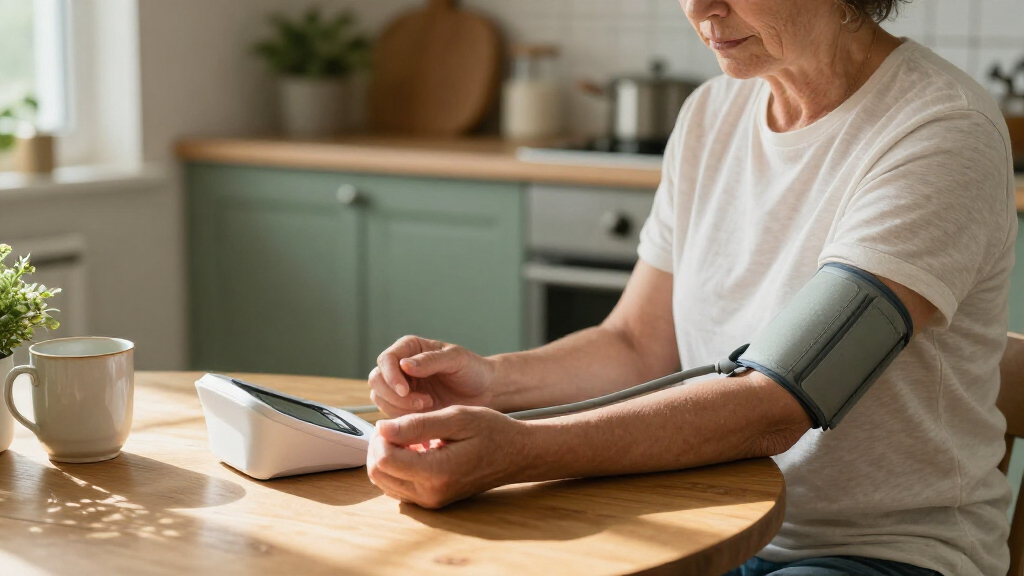
I ranked these 15 monitors around the needs that shape reliable home tracking: cuff fit and placement, ease of taking and recording readings, display clarity, portability, and the usefulness of any app or added heart-rhythm feature. Upper-arm monitors generally ranked ahead for everyday measurement because they suit a repeatable seated routine; wrist models remain useful for buyers who need a smaller device or cannot comfortably use an upper-arm cuff, provided they can position the wrist correctly.
The order also reflects how much a product’s extra features help its intended buyer. Straightforward models such as OMRON Silver rank ahead as broadly useful choices, while AFib-screening, EKG, wireless, and app-based models move up for readers who will use those functions. I gave credit to clear fit advantages, such as a wide-range cuff, and treated added complexity as a tradeoff rather than an automatic benefit. A product’s stated screening or EKG function does not replace clinical diagnosis; buyers should follow their healthcare professional’s guidance.
| blood pressure monitor | Connectivity |
|---|---|
| OMRON Silver Upper Arm Blood P | Bluetooth |
| iHealth Neo Wireless Upper Arm | Bluetooth 4.0 |
| OMRON Platinum Upper Arm Blood | Bluetooth |
| OMRON Complete 2-in-1 Upper Ar | Bluetooth |
| Oklar Rechargeable Wrist Blood | — |
| Oklar Upper Arm Blood Pressure | — |
| OMRON Evolv Wireless Upper Arm | Bluetooth |
| Automatic No-Wrap Upper Arm Bl | — |
| OMRON Gold Upper Arm Blood Pre | Bluetooth |
| OMRON Bronze Upper Arm Blood P | Bluetooth |
| OMRON Gold Wireless Wrist Bloo | Bluetooth |
| OMRON Iron Upper Arm Blood Pre | — |
| iHealth Track Smart Upper Arm | Bluetooth 4.0 or later |
| Dario Gen-2 Upper Arm Blood Pr | Bluetooth; Dario app sync for User 1 |
| iHealth Track Pro Upper Arm Bl | — |
Factors to Consider When Choosing Best Blood Pressure Monitors
Before choosing among these monitors, decide what will make regular measurement practical for you. A more feature-rich device is not automatically a better fit: cuff compatibility, positioning, and a repeatable routine often have more impact on useful tracking than wireless extras.
Choose a cuff that fits your arm
Measure your upper arm before choosing a cuff, and compare that measurement with the manufacturer’s stated range. A cuff that is too small or too large can undermine readings, even when the monitor itself is easy to use. A wide-range cuff may suit more household members, but it still needs to fit each person within its stated limits. Do not assume that a family member’s fit means the same cuff works for you. If your arm shape makes standard cuffs hard to position, check the available cuff design and instructions before prioritizing app features.
Pick upper-arm or wrist based on your routine
Upper-arm monitors are a practical starting point for many home users because they fit a seated measuring routine and are less dependent on holding a small device at a precise height. Wrist monitors are smaller and can be easier to store or carry, but wrist position relative to the heart can affect the reading. A wrist model may suit someone who cannot comfortably use an upper-arm cuff, yet it is not automatically the better choice simply because it is compact. Ask your clinician which style is appropriate if you have questions about your measurements or arm fit. Whichever format you choose, use the same arm and setup when recording readings, following the device directions.
Decide whether app connectivity will help you stay consistent
Bluetooth and companion apps can make it easier to keep a history and share records, but they add setup steps and may depend on a compatible phone. Think about whether you already use a health app and whether you will actually review or share the saved data. A clear on-device display may be more useful than wireless syncing for someone who wants a quick reading without a phone nearby. Check how readings are stored and whether more than one person can keep records separate before using a monitor across a household. Connectivity is most helpful when it removes work from a routine you already plan to follow.
Treat AFib and EKG features as specialized tools
AFib screening and EKG functions add information beyond a standard blood pressure reading, which can appeal to buyers whose care plan calls for heart-rhythm monitoring. Those features do not diagnose a condition or replace an appointment, and a normal result should not be treated as proof that no problem is present. Added functions may also mean a more involved measurement process and more results to interpret. Before paying for a monitor with these tools, ask your clinician whether they suit your situation and how to respond to an alert. If you only need routine blood pressure tracking, a simpler model may be easier to use consistently.
Build the measurement habit before adding features
A monitor can only support useful tracking if you follow its directions and take readings under similar conditions. Sit quietly, use the correct cuff placement, and avoid comparing readings taken with different positions or routines as if they were equivalent. Read the manual for your specific device, since cuff placement and operation vary across models. If several people will use the monitor, plan how each person will record results without mixing up histories. For many buyers, a device that is easy to set up and repeat each day is a better fit than one with features they rarely use.
Check portability, power, and household use
Consider where the monitor will live and whether you need to take it on trips or to appointments. Compact wrist models and integrated wireless designs can reduce storage bulk, while a separate upper-arm cuff and monitor may be easier to keep organized in one home location. Check whether the model uses batteries, is rechargeable, or needs another power arrangement, then decide which routine you can maintain. If the device is shared, clear user separation and a cuff that fits each person deserve more attention than a travel case alone. Portability matters most when it makes regular measurements easier rather than merely making the device smaller.
Frequently Asked Questions
Should I choose an upper-arm monitor or a wrist monitor?
For a routine home setup, an upper-arm model is a sensible default because it works with a stable seated measurement routine. Wrist models such as the Oklar Rechargeable or OMRON Gold Wrist are more compact and may help if an upper-arm cuff is uncomfortable or impractical. Their readings depend more on holding the wrist at the correct height, so positioning mistakes are easier to make. Check with a healthcare professional if you are unsure which style suits your needs. Choose the format you can use correctly and consistently, not just the one that is easiest to carry.
Is an AFib or EKG feature worth choosing over a basic monitor?
It can be useful when a clinician has recommended heart-rhythm screening or you have a clear plan for using the extra results. The OMRON Platinum and Gold add AFib-related screening, while the OMRON Complete combines blood pressure measurement with an EKG function. These tools do not diagnose a condition, and they do not replace medical evaluation. If your priority is routine blood pressure tracking, a simpler monitor may reduce unnecessary steps. Ask your clinician how to interpret any alerts before relying on a specialized feature.
What should I do if a standard cuff does not fit my arm?
Measure your arm and compare it with the cuff range listed for the specific monitor; do not guess based on the cuff’s appearance. The iHealth Track Smart is a notable option in this group because it specifies a wide-range cuff, but you should still confirm that your measurement falls within its stated range. An ill-fitting cuff can make readings less useful regardless of the monitor’s other features. If no included cuff fits, contact the manufacturer or ask a clinician about a suitable alternative rather than forcing the cuff closed. Fit should take priority over wireless functions or screening extras.
Will I need a smartphone to use a connected blood pressure monitor?
Wireless models such as OMRON Evolv and iHealth Neo are designed to connect with an app, but a phone can add setup and account steps. Check the product instructions for which functions work on the device itself and which depend on the app before buying. If you prefer not to use a phone, a model with a clear display and a recording method that suits you may be easier to maintain. App history can help when you need to share readings, but only if you will keep the device connected and use the records. Choose connectivity for a task you want it to simplify.
Can I use one monitor for multiple people in my household?
Possibly, but each user needs a cuff that fits and a reliable way to keep their readings separate. Check whether the monitor offers distinct user profiles or whether you will need to record results independently. Sharing a device can be less convenient if users have different arm sizes or if the monitor does not clearly separate histories. Follow the manufacturer’s cleaning and storage guidance between users, and avoid assuming one person’s cuff fit applies to another. If the device’s memory or app setup makes records easy to mix up, separate monitors may be a better fit.
Conclusion
For most people who want routine home readings, I’d choose the OMRON Silver as the best overall pick for its straightforward focus. The iHealth Track Smart is my best value-style choice for buyers who need its wide-range cuff, while the OMRON Platinum is the best premium option for people who have a reason to use AFib screening. For beginners, I’d start with a simple upper-arm model such as OMRON Silver or OMRON Bronze rather than paying for features that may go unused. For compact needs, choose an Oklar or OMRON wrist monitor only if you can follow its positioning directions; for app-based tracking, compare OMRON Evolv with iHealth Neo. The right choice is the one with a correctly fitting cuff and a routine you can repeat.