
TL;DR

Get health and wellness essentials delivered free with Prime
- Fast, free delivery on millions of items
- Prime Video, Amazon Music and more included
- Member-only deals all year
Fit&Well reports that physical therapist Dr. Marivi Lao recommends a figure-four stretch, a kneeling hip-flexor stretch and a supine hip twist for hip mobility. Lao suggests starting with one to three repetitions, holding each for 20 to 30 seconds per side, two to four times a week, while avoiding pain or forced positions.
Physical therapist Dr. Marivi Lao recommends three stretches—a figure four, a kneeling hip-flexor stretch and a supine hip twist—as options for people seeking to improve hip mobility, according to a Fit&Well report. Lao says people who sit for long periods may feel hip stiffness when they stand, and advises starting gently rather than forcing a deeper stretch.
Lao, who works with Spear Physical Therapy, suggests beginning with one to three repetitions of each stretch, holding for about 20 to 30 seconds per side, two to four times a week. She says the movements can be done daily if someone enjoys them and they feel comfortable. The guidance is a starting point, not a prescribed routine for every person.
For the figure-four stretch, lie on your back with knees bent, cross one ankle above the opposite knee, then lift the supporting foot and gently draw that thigh toward your chest. Lao recommends keeping the crossed foot flexed and relaxing the shoulders and pelvis. The stretch should be felt mainly in the glute and outer hip; discomfort in the knee or a pinching feeling in the hip is a reason to ease off or adjust. The move can be done on a bed if getting to the floor is difficult.
For the kneeling hip-flexor stretch, kneel with one foot planted in front and its knee bent, gently tilt the pelvis and move forward until a stretch is felt at the front of the opposite hip. Lao says to avoid arching the lower back or pushing the hips forward to manufacture more range. A standing lunge version is an alternative. The third option, a supine hip twist, starts on your back with knees bent; slowly lower both knees to one side, return to the center and repeat on the other side for 20 to 30 seconds. Lao describes it as gentle rotation, not a contest to reach the floor.
A Gentle Routine for Stiff Hips
The advice gives readers a short set of movements and a starting schedule, while putting comfort ahead of achieving a particular range. Lao defines mobility as having enough comfortable movement to get through daily activities without feeling restricted. That framing matters because flexibility varies between people, and the source does not claim that these stretches will resolve a medical condition or produce the same result for everyone.
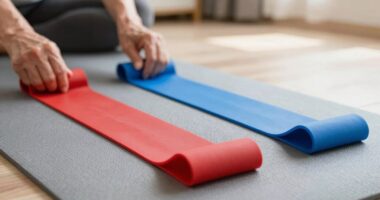
Lao also recommends pairing stretching with hip-strengthening exercises, giving resistance-band marches as an example. The report does not compare stretching alone with a combined routine or provide measured outcomes. Its practical takeaway is narrower: move regularly, use controlled stretches, and stop short of pain or strain.
As an affiliate, we earn on qualifying purchases.
Why Sitting Can Feel Restrictive
Lao says that when people sit for hours, their hips stay bent for a prolonged period, and it is common to feel stiffness or tightness when standing at the end of the day. Her recommendation is to move around regularly as well as try targeted stretches. The report presents this as her clinical guidance, not as a finding from a cited research study.
The three movements address different positions: the figure four targets the outer hip and glute area, the kneeling stretch focuses on the front of the hip, and the supine twist introduces gentle rotation. Lao emphasizes that stretching should not become a competition with oneself. She advises backing off if a person is holding their breath, tensing their whole body or struggling to force a deeper position.
“A good starting point is doing one to three repetitions of each stretch, holding for about 20-30 seconds per side, two to four times per week.”
— Dr. Marivi Lao, physical therapist with Spear Physical Therapy
As an affiliate, we earn on qualifying purchases.
Limits of the Stretching Advice
The source does not cite clinical trials, quantify how much these stretches improve mobility, or specify how quickly someone might notice a change. It also does not establish that the movements are appropriate for every person or explain how to adapt them for a particular injury or health condition. The recommended routine should be understood as general guidance attributed to Lao.
The report says to expect a gentle-to-moderate pulling sensation, not pain. It does not set out a detailed protocol for persistent or severe discomfort. People who have concerns about pain, injury or whether a movement is suitable can seek guidance from a qualified health professional.
As an affiliate, we earn on qualifying purchases.
How to Start and Adjust
Lao’s suggested starting point is to try one to three repetitions of each movement, holding for 20 to 30 seconds per side, two to four times weekly. The source does not announce a follow-up study or a set date for new guidance. Readers can adjust the position to stay comfortable, including doing the floor-based stretches on a bed if getting down to the floor is difficult.
During each movement, breathe normally and avoid pushing through pain, holding the breath or tensing the whole body. Lao says the hip-flexor stretch should come from movement at the hip rather than arching the lower back; for the twist, the knees do not need to reach the floor. She suggests adding targeted strengthening, such as resistance-band marches, but does not specify a schedule for those exercises.
As an affiliate, we earn on qualifying purchases.
Key Questions
Which three stretches does Dr. Lao recommend?
She recommends a figure-four stretch, a kneeling hip-flexor stretch and a supine hip twist.
How often should someone try the stretches?
Lao suggests starting with one to three repetitions, holding each for 20 to 30 seconds per side, two to four times a week. She says daily stretching may suit people who enjoy it and find it comfortable.
Should the stretches hurt?
No. Lao says to expect a gentle-to-moderate pull, not pain. She advises easing off if a stretch causes pain, prompts breath-holding or leads to whole-body tension.
Can the stretches be done without getting on the floor?
The report says the figure-four stretch and supine hip twist can be done on a bed if getting down to the floor is difficult. Lao also notes that a standing lunge can replace the kneeling hip-flexor stretch.
Does the report say stretching alone will improve hip mobility?
No measured results are provided. Lao recommends regular movement and says stretching can be paired with hip-strengthening exercises, such as resistance-band marches; the report does not quantify the effects of either approach.
Source: rss
Halloween Picks
halloween
As an affiliate, we earn on qualifying purchases.