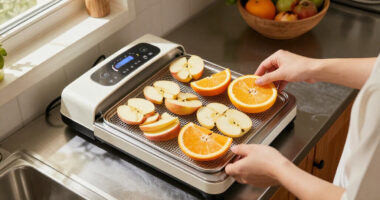
When shopping for an electric food dehydrator, the main choice is often between a stackable-tray model and a shelf-style machine. Both circulate warm air to remove moisture from fruit, vegetables, herbs, and other foods, but their layouts change how much you can dry at once and how much attention a batch needs. Stackable units tend to suit occasional use, limited counter space, and tighter budgets. Shelf-style machines usually offer more usable capacity, easier access to trays, and more consistent results across a full load. The best fit depends less on headline wattage than on how often you dehydrate, how large your batches are, and whether you want to rotate trays during drying.

Get health and wellness essentials delivered free with Prime
- Fast, free delivery on millions of items
- Prime Video, Amazon Music and more included
- Member-only deals all year
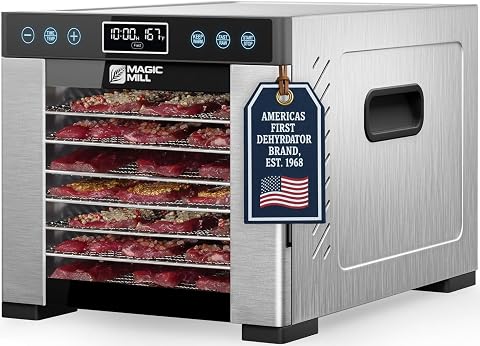
Magic Mill Pro Food Dehydrator Machine – 600W Rear Fan, 7 Stainless Steel Trays, 95°‑176°F Temperature Control, 48‑Hour Timer, Ke…
- ✔ Wattage: 600 watts
- ✔ Trays: 7 stainless-steel trays
- ✔ Temperature range: 95°F–176°F, adjustable in 1° increments
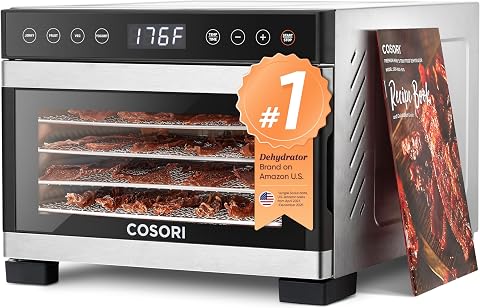
Cosori Food Dehydrator, 5 Stainless Steel Trays, 3.1 ft² Drying Space
- ✔ Wattage: 480 watts
- ✔ Trays and area: 5 stainless-steel trays; 3.1 sq. ft.
- ✔ Tray size: 9 × 10 inches

Magic Mill Food Dehydrator Machine with 5 Stackable Stainless Steel Trays, Digital Timer and Adjustable Temperature up to 167°F
- ✔ Wattage: 240 watts
- ✔ Trays: 5 adjustable stackable stainless-steel trays
- ✔ Temperature range: 95°F–167°F
At a Glance
| Criteria | Stackable-tray dehydrators | Shelf-style dehydrators | Winner |
|---|---|---|---|
| Batch capacity | Usually modest; add-on trays may expand capacity on some models | Often larger, with several pull-out shelves | B |
| Drying consistency | Can vary by tray position; rotating trays may improve uniformity | Typically more even airflow across loaded shelves, though design matters | B |
| Tray access and rotation | Adding or removing a middle tray can require lifting the stack | Individual shelves slide out for checking or removal | B |
| Storage and footprint | Often compact to store, though tall stacks use vertical space | Uses more counter space and can be bulky to store | A |
| Noise | Varies by fan and build; often modest, but model-specific | Fan noise varies; some larger units are audible during long cycles | Depends |
| Cleanup | Plastic trays may be dishwasher-safe; check manufacturer guidance | Flat shelves are easy to load and unload but still require washing | B |
| Value | Lower entry cost suits occasional, smaller batches | Higher cost pays off for frequent use and larger batches | Depends |
Magic Mill Pro Food Dehydrator Machine – 600W Rear Fan, 7 Stainless Steel Trays, 95°‑176°F Temperature Control, 48‑Hour Timer, Ke…
The Magic Mill Pro is the most capable option here for households that dehydrate in substantial or mixed batches. Its seven full-size stainless-steel trays give it two more levels than the Cosori cabinet, while its 600-watt rating is the highest of these three models. That combination makes it the clearest fit when one session might include fruit, vegetables, herbs, or jerky rather than a single small load.Its rear fan moves air horizontally through the cabinet, avoiding the bottom-up arrangement of the stackable Magic Mill. The stated design is intended to distribute airflow without hot spots, and the temperature range reaches 95°F to 176°F with one-degree adjustments. That fine setting control is useful for buyers who want to match different foods more closely; it is a meaningful distinction from the stackable model, which stops at 167°F.The 48-hour timer, automatic shutoff, and keep-warm mode support longer, less hands-on drying sessions. In exchange, this is the heaviest option in the lineup at 7.26 kg, and the rear fan is not removable for cleaning. Buyers with limited counter space or small batches may find Cosori’s five-tray cabinet easier to accommodate. We rank the Pro first because it balances capacity, temperature range, and timed operation better than the alternatives for frequent, varied use, while acknowledging its size and cleaning limitation.
Pros:
- Seven full-size stainless-steel trays provide the largest listed tray capacity here.
- Rear-fan airflow and 95°F–176°F temperature control suit a broad range of drying tasks.
- One-degree adjustments, a 48-hour timer, keep-warm mode, and automatic shutoff offer detailed session control.
- ETL listing and overheat protection are specified.
Cons:
- At 7.26 kg, it is less convenient to move or store than the other models.
- The rear fan is not removable, which can make cleaning less straightforward.
Best for: Households that regularly dry larger batches or want fine temperature control across different foods.
Not ideal for: Buyers with limited counter or storage space, occasional small-batch users, or anyone prioritizing easy access to the rear fan for cleaning.
Bottom line: We recommend the Magic Mill Pro for frequent, varied drying when its seven trays and detailed controls justify the heavier cabinet.
“We recommend the Magic Mill Pro for frequent, varied drying when its seven trays and detailed controls justify the heavier cabinet.”
Cosori Food Dehydrator, 5 Stainless Steel Trays, 3.1 ft² Drying Space
Cosori makes the most sense when we want a cabinet-style dehydrator but do not need the Pro’s seven-tray capacity. Its five stainless-steel trays provide 3.1 square feet of drying space, and the unit measures 13.9 × 11.3 × 8.9 inches. That compact rectangular form should be easier to place on a kitchen counter than the larger Magic Mill Pro, while still keeping the horizontal rear-fan layout shared by both cabinet models.The temperature range matches the Pro at 95°F to 176°F in one-degree increments, and the timer also runs as long as 48 hours. Four preset programs offer a more guided way to start a session than choosing every setting manually. These presets distinguish it from the Pro’s listed control features, although the supplied details do not specify the programs’ individual settings. The listed tray size is 9 × 10 inches, so buyers should consider whether that area suits their typical portions before expecting the Pro’s larger batch capacity.Cosori’s tradeoff is a more limited listed load and button-based adjustment rather than a built-in digital display. Its controls still provide fine temperature increments, but buyers who prefer a display showing settings at a glance may find that omission inconvenient. Compared with the stackable Magic Mill, Cosori has a higher maximum temperature and rear horizontal airflow; compared with the Pro, it gives up two trays and listed keep-warm operation. We place it second because it offers a good balance of compactness, stainless-steel trays, and control for everyday countertop use.
Pros:
- Compact cabinet dimensions help it fit more easily on a countertop.
- Five stainless-steel trays provide 3.1 square feet of drying area.
- One-degree temperature adjustments, four presets, and a timer up to 48 hours support varied sessions.
- Rear horizontal airflow distinguishes it from the stackable Magic Mill design.
Cons:
- Five trays provide less listed capacity than the seven-tray Magic Mill Pro.
- Settings use buttons without a built-in digital display.
Best for: Cooks who want a compact cabinet-style dehydrator with stainless-steel trays, presets, and precise temperature adjustment.
Not ideal for: Large-batch users who need seven trays, or buyers who specifically want a built-in digital display.
Bottom line: Cosori is our compact cabinet pick for buyers who want guided settings and precise control without stepping up to seven trays.
“Cosori is our compact cabinet pick for buyers who want guided settings and precise control without stepping up to seven trays.”
Magic Mill Food Dehydrator Machine with 5 Stackable Stainless Steel Trays, Digital Timer and Adjustable Temperature up to 167°F
This five-tray stackable Magic Mill takes a different approach from the two enclosed cabinets: trays sit in a vertical stack rather than sliding into a rear-fan chamber. Its 8.5 × 11.8 × 11-inch footprint may appeal to buyers who want a modest setup for fruit, vegetables, meat, or pet treats and do not need the Pro’s seven levels. The trays are adjustable to make room for thicker-cut foods, adding some flexibility to the stacked layout.Its 95°F–167°F temperature range covers many common dehydration tasks, but the lower ceiling is a clear difference from both cabinet models, which reach 176°F. It has a digital timer and temperature control, while the Cosori offers four presets and horizontal airflow. The product description specifies a 240-watt rating; that figure is lower than the 480-watt Cosori and 600-watt Pro, but wattage alone does not establish drying speed, so we would not treat it as a direct performance guarantee.Stainless-steel trays provide a durable food-contact surface, while the body is BPA-free plastic. That construction is less uniform than the all-stainless approach described for the Pro and Cosori, though a plastic body may suit buyers who do not need a stainless cabinet. This is our third pick because its stackable design and adjustable trays support straightforward, smaller sessions, but the narrower temperature range and different airflow layout make it less versatile than the rear-fan choices. The supplied details do not specify an exact timer duration, so buyers seeking a long programmed run should confirm that before choosing.
Pros:
- Five stackable stainless-steel trays handle several food types in one session.
- Adjustable tray spacing accommodates thicker-cut foods.
- Digital timer and temperature control offer direct session adjustments.
- BPA-free plastic body keeps the exterior materials distinct from the all-stainless cabinet options.
Cons:
- Its 167°F maximum is lower than the 176°F ceiling on the other two models.
- The stackable layout differs from the rear-fan cabinet airflow approach.
- The supplied specifications do not state the timer’s maximum duration.
Best for: Occasional users who want five stackable trays, adjustable tray spacing, and a smaller setup for common drying projects.
Not ideal for: Buyers who need a maximum temperature of 176°F, a rear-fan cabinet design, or a specified long timer duration.
Bottom line: Choose this Magic Mill for a simple stackable setup and smaller workloads, provided its lower temperature ceiling fits your drying plans.
“Choose this Magic Mill for a simple stackable setup and smaller workloads, provided its lower temperature ceiling fits your drying plans.”
As an Amazon Associate we earn from qualifying purchases.
Key Differences
The layout shapes everyday use. A stackable dehydrator builds upward, with trays arranged above its heat source or fan. That keeps the footprint relatively small and makes entry-level models accessible, but airflow and heat can differ from the bottom to the top. Depending on the design and the food load, you may need to rotate trays or check pieces at different times. A shelf-style dehydrator uses pull-out trays inside a cabinet-like body. Its airflow system is generally designed to circulate air across the shelves more evenly, and each shelf can be checked without dismantling the load.
That difference matters most when a full batch takes many hours or when the food is cut in varying sizes. Shelf-style machines are more convenient for repeat batches of jerky, fruit, or garden produce, but they take more room and usually cost more. A stackable unit can be the better purchase if you process small quantities now and then, have little storage space, or want to try dehydrating without a large outlay. Capacity claims alone can mislead: compare usable tray area and spacing, since tightly packed food can slow drying in either format.
Detailed Comparison
Batch capacity (Shelf-style dehydrators wins — moderate)
Shelf-style usually wins by a moderate margin. Cabinet designs commonly provide several broad shelves, making it easier to spread out a large harvest or prepare multiple trays of snacks at once. Stackable models can still handle meaningful batches, and some accept extra trays, but adding height does not always provide the same practical area or convenient access. If you dehydrate just a few apples or herbs, the extra shelf area may sit unused. For meal prep, preserving garden produce, or repeated family-size batches, the shelf-style format can reduce the number of separate runs.
Drying consistency (Shelf-style dehydrators wins — moderate)
Shelf-style has a moderate advantage in typical use. Many models use a rear-mounted fan and are built to distribute air across pull-out shelves, so pieces can dry at a more similar pace without frequent intervention. Stackable designs may have more noticeable differences by tray position, particularly when airflow comes from below; rotating trays can help. Neither format guarantees uniform results: tray spacing, fan placement, food thickness, and how densely you load it all matter. The practical gain is fewer checks and less tray shuffling with a well-designed shelf-style unit.
Tray access and rotation (Shelf-style dehydrators wins — moderate)
Shelf-style wins, with a moderate convenience gap. Pull-out shelves let you inspect a particular batch, remove finished pieces, or rearrange food without taking apart the entire machine. In a stackable unit, reaching a lower tray may mean lifting off the trays above it. That is manageable for a small load, but becomes tedious during a long cycle with several trays. If you expect to check progress often or have foods with different drying times, individual shelf access makes the workflow simpler.
Storage and footprint (Stackable-tray dehydrators wins — moderate)
Stackable usually wins for storage, though the gap is minor to moderate. Many units have a smaller base and can be taken apart for storage, which helps when cabinet space is limited. Their tall shape still needs clearance on the counter, and a full stack can be awkward to move. Shelf-style machines are box-shaped, heavier, and often need a dedicated cupboard or counter spot. Measure both the appliance and the shelf clearance before buying; a compact base does not help if the stack blocks upper cabinets.
Noise (minor difference)
There is no dependable format winner. Both types use a fan, and dehydrating often runs for hours, so even moderate fan noise can matter in an open-plan home or overnight. A larger cabinet does not automatically mean a quieter machine, and a compact stacker can still have a noticeable motor. Treat noise as model-specific: look for reliable descriptions of fan sound and consider where the machine will run. If noise sensitivity is a priority, this criterion should weigh more than the general format.
Cleanup (Shelf-style dehydrators wins — minor)
Shelf-style has a small practical edge. Flat shelves are easy to slide out and load over a sink or counter, and they are generally straightforward to wipe or wash. Stackable trays may also be dishwasher-safe, but their shape and quantity can make handwashing awkward, especially if the food leaves sticky residue. Cleaning convenience ultimately comes down to tray material, whether the shelves are dishwasher-safe, and the number of parts. Check care instructions before purchase because dishwasher use can warp some trays.
Value (major difference)
The winner depends on how often you will use it. Stackable models commonly offer a lower-cost way to dry occasional snacks or herbs. If you only run a few small batches a year, paying more for a cabinet machine may not repay you in time saved. Shelf-style costs more, but the premium can make sense when larger capacity and reduced tray handling help you run frequent batches. Compare the full feature set, including adjustable temperature and a timer, rather than assuming every machine in one format has the same controls.
Stackable-tray dehydrators: Pros and Cons
Pros:
- Often costs less to buy
- Compact base and separable trays can simplify storage
- A practical choice for small or occasional batches
Cons:
- Tray position can affect drying speed and may call for rotation
- Accessing a lower tray can require lifting the stack
- Usable capacity may be limited for frequent large batches
Shelf-style dehydrators: Pros and Cons
Pros:
- Often provides more usable area for larger batches
- Pull-out shelves make checking and unloading easier
- Many designs distribute air more evenly across trays
Cons:
- Usually costs more
- Takes more counter and storage space
- Fan noise can be noticeable during long drying cycles
Who Should Choose What
Choose Stackable-tray dehydrators if:
- You want an affordable first dehydrator for occasional fruit, herbs, or small snack batches.
- You have limited storage and prefer a smaller appliance that can be taken apart.
- You are comfortable checking progress and rotating trays when a batch dries unevenly.
Choose Shelf-style dehydrators if:
- You regularly dry large batches of produce, meat, or snacks.
- You value easy access to individual trays and less hands-on rearranging.
- You have room for a cabinet-style appliance and expect to use it often enough to justify the higher cost.
Skip both if: You only expect to dry a small amount once or twice and lack space for a machine; a borrowed dehydrator or another suitable preservation method may make more sense.
Value for Money
Paying more for a shelf-style dehydrator is worthwhile when its capacity and easier tray access will save time across frequent or large batches. That premium buys convenience and room to process more food at once; it does not automatically produce better results if the unit is poorly designed or overcrowded. For occasional use, a stackable machine is generally better value because the lower purchase cost matches the workload. Compare usable tray area, temperature controls, timer features, cleanup instructions, and the warranty before treating a higher price as a sign of better performance.
Final Verdict
For most people who plan to dehydrate regularly, a shelf-style model is the stronger choice: it holds larger batches and makes checking, unloading, and getting consistent results easier. Choose a stackable unit if low upfront cost, compact storage, and occasional small batches matter more than hands-off convenience. The deciding factor is how often you will fill the machine: frequent users are more likely to benefit from paying extra for shelves and capacity, while casual users can keep the savings.
Frequently Asked Questions
Do shelf-style dehydrators dry food more evenly?
Many are designed to distribute air across the shelves, which can reduce differences between tray positions. Results still depend on fan placement, loading density, food thickness, and the machine’s design. Stackable units may need tray rotation to even out drying.
Is a stackable dehydrator good for beginners?
Yes, especially if you want to try small batches without spending much or using a large appliance. Check whether it has adjustable temperature controls, and expect to monitor the food as it dries. A shelf-style unit is easier if you plan to make larger batches from the start.
Is higher wattage better in a food dehydrator?
Wattage alone does not show how evenly or quickly a machine will dry food. Airflow, temperature control, tray area, food spacing, and the size of the load all affect results. Compare those features alongside wattage rather than choosing by the largest number.
How much space do I need for a dehydrator?
Measure the appliance’s width, depth, and height, plus room for ventilation and access to its trays. Stackable machines often have a smaller base but can be tall in use. Shelf-style machines take up a box-shaped area and may be heavier to move for storage.