TL;DR

Get health and wellness essentials delivered free with Prime
- Fast, free delivery on millions of items
- Prime Video, Amazon Music and more included
- Member-only deals all year
Fit&Well reports that personal trainer Chris Browning recommends shoulder presses, squats, planks, dumbbell rows and glute bridges as a beginner home-strength routine. The report suggests two to three sets of each exercise, using light dumbbells where needed and prioritizing proper form.
Fit&Well has published a five-exercise home-strength routine for beginners, based on recommendations from personal trainer Chris Browning. It pairs bodyweight movements with light dumbbell exercises, with the stated aim of covering major muscle groups using exercises that can be progressed as they become more familiar.
Browning recommends a seated dumbbell shoulder press, bodyweight squat, plank, dumbbell row and glute bridge. The Fit&Well report says the exercises were chosen because they are relatively simple to teach and learn, allow progression and collectively target major muscles. It recommends two to three sets of each movement; repetitions are generally set at 10 to 15, while the plank is timed.
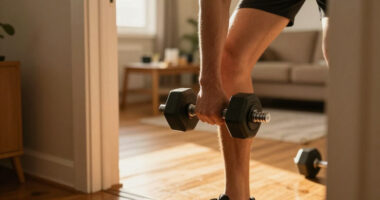
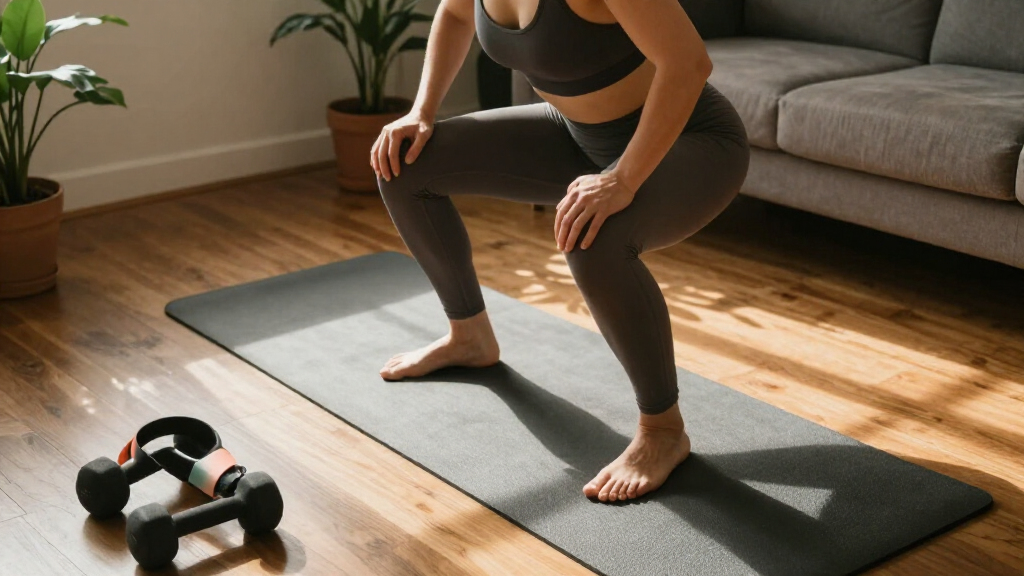
For the shoulder press, sit upright on the floor with a dumbbell in each hand at shoulder height. Press the weights overhead until the arms are nearly straight, then lower them under control. The report suggests 10 to 15 repetitions and advises keeping the core engaged. For squats, stand with feet roughly shoulder-width apart, bend the hips and knees as far as comfortable while keeping the feet flat, then push back to standing. Arms can reach forward for balance.
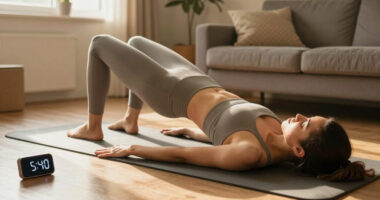
The plank begins on hands and knees before the body is extended into a straight line, with forearms on the floor and elbows beneath the shoulders. Browning recommends holding for 30 to 60 seconds, but says beginners should stop when the position becomes challenging or uncomfortable, or when they can no longer keep good form. For the row, begin on hands and knees, lift a dumbbell toward the hip with one arm while keeping the back flat, and lower it slowly; repeat for 10 to 15 reps per side. The glute bridge is performed lying on the back with knees bent: lift the hips until the body forms a line from chest to knees, squeeze the glutes, then lower. The suggested range is also 10 to 15 reps.
A Simple Full-Body Starting Point
The routine offers beginners a defined set of movements rather than requiring gym machines or a complex program. Squats and bridges train lower-body movement, while presses and rows add upper-body work; the plank challenges trunk stability. Together, those choices give readers a practical outline for a home session, although the source does not present them as a personalized plan or a substitute for professional coaching.
Its emphasis on light weights and controlled form addresses a common beginner concern: how to start without making the workout too demanding. Fit&Well advises using a pair of fairly light dumbbells to challenge the muscles safely and increasing the weight only after the exercises feel easy, potentially after a few weeks of practice. That is guidance from the report, not a guarantee that the same schedule or load suits every person.
Products Worth Considering

BowFlex Results Series SelectTech 552 Adjustable Dumbbell

BowFlex SelectTech 840 Adjustable Kettlebell

Fitbit Sense Advanced Smartwatch – Sage Grey/Silver (One Size, S & L Bands Included)
As an affiliate, we earn on qualifying purchases.
How the Five Moves Were Chosen
The recommendations come from a Fit&Well report on home strength training. The publication identifies Browning as a personal trainer with more than 20 years of experience creating home workouts for clients. His selection focuses on movements he describes as straightforward to learn and capable of progression.
The routine uses bodyweight and light dumbbells, with no other equipment specified in the supplied report. It gives set and repetition targets, but does not lay out weekly frequency, rest periods, a warm-up, or a longer-term progression schedule. Those omissions mean readers should treat it as a list of exercises and starting ranges, not a complete individualized training program.
Limits of the Published Routine
The source does not specify a publication date in the supplied material, nor does it report results from a study comparing these exercises with other routines. The phrase “five best” is the article’s framing; the supplied details do not establish that this list is objectively superior for every beginner. Individual ability, equipment, health history and training goals can affect which movements are appropriate.
It is also unclear how often readers should complete the sequence, how long to rest between sets, or exactly how to choose an initial dumbbell weight. Fit&Well says to increase weight when the exercises feel easy after practicing for a few weeks, but gives no fixed progression rule. Anyone with an injury, a health concern or uncertainty about safe exercise should seek guidance from a qualified health or fitness professional before starting or changing a program.
Progress Gradually With Practice
The next step described in the report is to practice the five movements with light dumbbells and manageable repetitions, keeping each movement controlled. When the exercises start to feel easy after a few weeks, Browning’s guidance is to consider increasing the weight. The report does not give a required timetable, so progression should depend on maintaining sound form rather than reaching a particular date or load.
Readers looking to use the routine as a regular program will need to decide on training frequency and rest periods, details the supplied article does not provide. The report’s immediate takeaway is narrower: learn the movements, use the suggested ranges as a starting point, and stop a plank when form fails or the hold becomes uncomfortable.
Key Questions
Which five exercises does the report recommend?
Fit&Well lists the seated dumbbell shoulder press, bodyweight squat, plank, dumbbell row and glute bridge, based on recommendations from personal trainer Chris Browning.
What equipment is needed?
The routine uses a pair of fairly light dumbbells for shoulder presses and rows. Squats, planks and glute bridges use bodyweight; the supplied report does not specify other equipment.
How many sets and repetitions are suggested?
The report suggests two to three sets of each exercise. Most movements are set at 10 to 15 repetitions; rows are 10 to 15 per side, and planks are listed at 30 to 60 seconds.
When should a beginner increase the dumbbell weight?
Browning’s guidance, as reported by Fit&Well, is to consider increasing the weight once the exercises feel easy after practicing for a few weeks. The report does not specify a precise weight increase or fixed schedule.
Source: fitandwell.com