TL;DR

Get health and wellness essentials delivered free with Prime
- Fast, free delivery on millions of items
- Prime Video, Amazon Music and more included
- Member-only deals all year
Yogalina Studios founder Alina Boyett has shared a four-movement, beginner-friendly yoga flow intended for gentle recovery after exercise or prolonged sitting. The sequence uses no equipment and includes guidance to move comfortably, avoid forcing stretches and seek professional advice when an injury or medical condition is relevant.
Fit&Well has published a four-pose recovery yoga flow from Alina Boyett, founder of UK-based Yogalina Studios, for people who want gentle movement after a workout, a run or a day spent sitting. The equipment-free sequence is presented as suitable for beginners and focuses on the legs, hips, spine and shoulders, with Boyett advising readers to stay within a comfortable range and not push through pain.
The sequence, demonstrated in a video by Yogalina teacher Misha Clarke, combines restorative poses, a forward fold and a seated twist. Boyett says the movements were selected to address areas that commonly feel tense after exercise. Fit&Well describes the flow as requiring no previous yoga experience, specialist equipment or advanced flexibility.
It begins with Waterfall pose, also called viparita karani: lie on your back near a wall and extend the legs upward, keeping the knees softly bent if needed. Boyett suggests holding for three to five breaths. The next pose, Child’s pose, starts on hands and knees; lower the hips toward the heels, extend the arms and rest the forehead if comfortable, again for three to five breaths.
For the third movement, a ragdoll forward fold, stand with feet hip-width apart, soften the knees and fold from the hips, letting the upper body hang. The instructions call for two rounds of three to five breaths, with a slow, bent-knee return to standing. The flow ends with a seated spinal twist, performed on both sides for two to three breaths per side. Boyett advises rotating gently rather than forcing the movement.
A Short Routine for Recovery
The report frames the sequence as a way to make recovery part of an exercise routine, rather than treating rest as simply doing nothing. Boyett says a few minutes of slower movement and breathing may change how someone feels, and recommends approaching recovery with intention. Those are her recommendations and observations, not evidence in the report that this particular flow produces a measured health or flexibility outcome.
For readers looking for a low-equipment option, the practical value is that the instructions can be followed at home and do not require advanced poses. The four movements offer a gentle alternative to more demanding exercise on a recovery day or after prolonged sitting. The source does not establish that the flow is appropriate for every person, nor does it give a clinical assessment of its effects.
Products Worth Considering

Withings Body Smart Wi-Fi and Bluetooth Smart Scale

Garmin Forerunner 55 GPS Running Smartwatch, Black

Oral-B iO Series 3 Rechargeable Electric Toothbrush for Adults, Black, with 2 Brush Heads and Travel Case
As an affiliate, we earn on qualifying purchases.
Four Poses and Their Instructions
Boyett connects the routine to several everyday situations, including finishing a challenging workout, going for a long run and spending extended time at a desk. She says the sequence is intended to encourage people to slow down and notice how their bodies feel, rather than to push for a deeper stretch. The source recommends moving slowly and within a comfortable range.
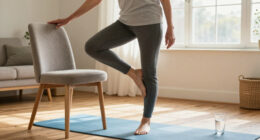
The poses move from lying down to kneeling, standing and sitting. In Boyett’s description, Waterfall is for resting tired legs; Child’s pose gently stretches the back, hips and shoulders; the forward fold targets the back of the body; and the seated twist introduces gentle rotation through the torso. These descriptions are attributed to Boyett and should be understood as her explanation of the sequence, not a guarantee that a pose will relieve a particular symptom.
Limits and Individual Suitability
Fit&Well’s report does not cite a clinical trial or provide measured results for the four-pose routine. It does not establish how much the flow improves flexibility, reduces muscle soreness or affects recovery compared with rest or other forms of movement. Boyett’s descriptions of how individual poses may feel are attributed guidance, not demonstrated outcomes.
The report also does not specify modifications for every mobility level or health circumstance. Boyett says people with an injury or relevant medical condition should seek appropriate professional guidance before trying the sequence. Readers should stop if a movement causes pain and should not treat the routine as a substitute for personalized care.
How Readers Can Try the Flow
The source does not announce a follow-up study, formal program or further testing. Readers can refer to Fit&Well’s instructions and Clarke’s demonstration to see how the four poses are performed. Anyone trying the routine can follow Boyett’s stated limits: use a comfortable range, soften the knees where the instructions call for it, and avoid forcing a stretch or twist.
For people with an injury or relevant medical condition, the next step identified in the report is to consult an appropriate professional before attempting the sequence. Whether the flow suits a particular person, and whether it changes their flexibility or recovery, remains individual and is not quantified in the source.
Key Questions
What does the beginner-friendly yoga flow include?
It includes Waterfall pose, Child’s pose, a ragdoll forward fold and a seated spinal twist. Fit&Well says Yogalina teacher Misha Clarke demonstrates the sequence.
Does the routine require equipment or yoga experience?
Boyett describes it as a home routine that needs no equipment, previous yoga experience or advanced flexibility. Waterfall pose uses a wall for support.
How long should each pose be held?
The instructions suggest three to five breaths for Waterfall and Child’s pose, two rounds of three to five breaths for the forward fold, and two to three breaths per side for the seated twist.
Is the sequence suitable for someone with an injury?
The report does not determine individual suitability. Boyett advises anyone with an injury or relevant medical condition to seek appropriate professional guidance before trying it, and says not to push through pain.
Does the report prove the flow improves flexibility or recovery?
No. The article presents Boyett’s routine and her explanation of its intended use, but provides no measured results or clinical evidence showing how much it affects flexibility, soreness or recovery.
Source: rss