TL;DR

Get health and wellness essentials delivered free with Prime
- Fast, free delivery on millions of items
- Prime Video, Amazon Music and more included
- Member-only deals all year
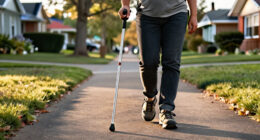
A preliminary study presented at the American Heart Association’s 2026 Hypertension Scientific Sessions found that adults older than 78 whose blood pressure was high at home but not in the office had a 70% higher rate of falls than peers with high readings in both settings. The findings show an association, not proof that masked high blood pressure causes falls, and the study’s authors say the reasons for the link remain unclear.
Adults older than 78 with high blood pressure readings at home but not at a medical appointment had a 70% higher rate of falls than peers whose readings were high in both settings, according to preliminary research presented at the American Heart Association’s Hypertension Scientific Sessions 2026. The study found an association, not evidence that masked high blood pressure causes falls.
The researchers analyzed 758 adults older than 78, grouping them by blood pressure readings taken in medical and home settings. They classified 15.4% as having masked high blood pressure, meaning their office readings were not high but their home readings were. Another 34.5% had high readings in both settings, 17.0% had high office readings but not high home readings (often called white coat high blood pressure), and 33.2% had normal readings in both.
During a median follow-up of 350 days, 23.4% of participants reported having fallen at least once during the previous 12 months. The reported 70% difference compares the rate of falls among participants with masked high blood pressure with the rate among those with high readings in both settings. The research summary does not provide the group-specific fall rates or a confidence interval for that comparison.
The analysis also found that, when office and home readings were considered as a continuous difference, lower office pressure relative to home pressure was associated with a higher incidence of falls. The study was presented as preliminary research at the meeting in Arlington, Virginia, held Oct. 7–11, 2026. Its findings have not been described in the supplied report as proof of a cause-and-effect relationship.
Why Home Readings May Matter
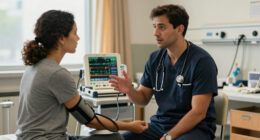
The results draw attention to a possible gap between a blood pressure reading taken during a clinic visit and a person’s readings at home. If office readings alone miss elevated pressure, home measurements may give clinicians additional information when assessing older adults. In this study, the difference between settings was associated with falls, an outcome that can affect mobility and independence.
The American Heart Association says falls are a leading cause of disability and functional decline among adults 65 and older, citing the U.S. Centers for Disease Control and Prevention. The study does not establish that treating masked high blood pressure would prevent falls, or that the blood pressure pattern explains the falls. Its significance is that the pattern may warrant closer attention in research and clinical assessment, rather than being treated as a proven explanation for an individual’s fall risk.
Presenting author Frances Wang said home measurements can help identify hidden high blood pressure and provide information to share with a health care team. That is a research and care-planning implication, not a substitute for professional assessment or a recommendation to change medication without consulting a clinician.
automatic blood pressure monitor for elderly
As an affiliate, we earn on qualifying purchases.
As an affiliate, we earn on qualifying purchases.
Office and Home Readings Differ
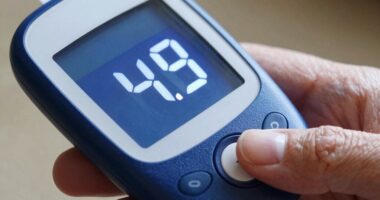
Blood pressure can be measured in a clinic and outside it, and the two settings do not always produce the same pattern. Masked high blood pressure describes readings that are not high in the office but are high at home. The reverse pattern—high in the office and not at home—is known as white coat high blood pressure. The study separated these patterns from sustained high blood pressure, in which readings were high in both settings.
The American Heart Association’s 2025 joint guideline recommends annual blood pressure monitoring for adults. It also recommends home monitoring to help confirm an office diagnosis and to track readings and progress as part of an integrated care plan. The guideline provides context for the study’s focus on home readings; it does not mean this preliminary analysis establishes a new fall-prevention treatment.
Falls are often associated with low blood pressure in discussions of older adults. The supplied research report notes emerging evidence linking high home blood pressure with falls as well. The current study adds an association involving masked readings, but it does not explain the biological or behavioral processes that might connect the two.
“These findings highlight that, in addition to office blood pressure measurement, home blood pressure readings can be an important way to identify hidden high blood pressure at home and risk of falls in older adults.”
— Frances Wang, Ph.D., M.S., study presenting author and researcher at Beth Israel Deaconess Medical Center
As an affiliate, we earn on qualifying purchases.
What the Fall Link Cannot Show
The study establishes an association in this group, but the supplied report does not show that masked high blood pressure caused falls. It also does not explain why the association appeared. Blood pressure variability or difficulties regulating pressure during the day are possibilities raised by Watson, who was not involved in the research, rather than findings confirmed by the analysis.
The report does not provide the absolute fall rate for each blood pressure group, the number of falls in each category, or details that would allow readers to assess the precision of the 70% comparison. It says participants self-reported falls during the previous 12 months and gives a median follow-up of 350 days, but does not clarify how the reported falls were distributed over that period. The summary also does not describe whether other factors that can affect falls were adjusted for.
Because this was preliminary research presented at a scientific meeting, the findings should not be read as proof that home blood pressure monitoring prevents falls or that changing blood pressure treatment would do so. The available material does not report a specific intervention, a clinical recommendation for people who have fallen, or results in adults younger than 79.
medical-grade blood pressure monitor for seniors
As an affiliate, we earn on qualifying purchases.
As an affiliate, we earn on qualifying purchases.
From Meeting Findings to Follow-Up
The study was presented at the American Heart Association’s Hypertension Scientific Sessions 2026, which ran Oct. 7–11 in Arlington. The supplied report does not identify a journal publication, additional planned analyses, or a next research milestone. Further peer-reviewed reporting and studies would be needed to establish how robust the association is, clarify what contributes to it, and test whether any change in care affects fall outcomes.
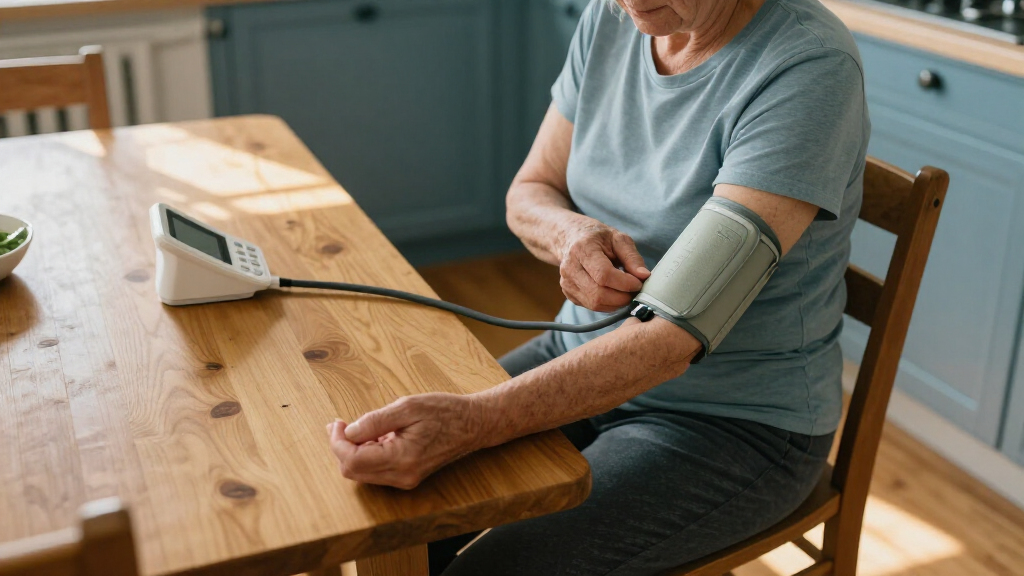
For now, Wang encouraged older adults, family members and caregivers to consider regular home blood pressure measurements and to share the readings with a health care team. The Association’s guideline supports home monitoring within an integrated care plan. People should discuss how to measure and interpret readings with a qualified health professional, rather than using this preliminary finding to diagnose a condition or alter treatment on their own.
As an affiliate, we earn on qualifying purchases.
Key Questions
What does masked high blood pressure mean?
It means blood pressure is not high in the office but is high at home. In the study, researchers distinguished this pattern from high readings in both settings and from high readings only in the office.
How much higher was the fall rate?
Among adults older than 78, the group with masked high blood pressure had a 70% higher fall rate than the group with high readings in both the office and at home. The supplied report does not give the absolute rate for either group.
Does the study show that masked high blood pressure causes falls?
No. It reports an association and does not establish that the blood pressure pattern caused participants to fall. The researchers did not explain the reason for the link in the supplied findings.
Should older adults start checking blood pressure at home?
The American Heart Association’s 2025 guideline recommends home monitoring as part of an integrated care plan, including to help confirm an office diagnosis and track readings. People should ask a qualified health professional how to measure and interpret their readings; the study is not a reason to change medication without medical guidance.
Source: rss
Halloween Picks
halloween
As an affiliate, we earn on qualifying purchases.